
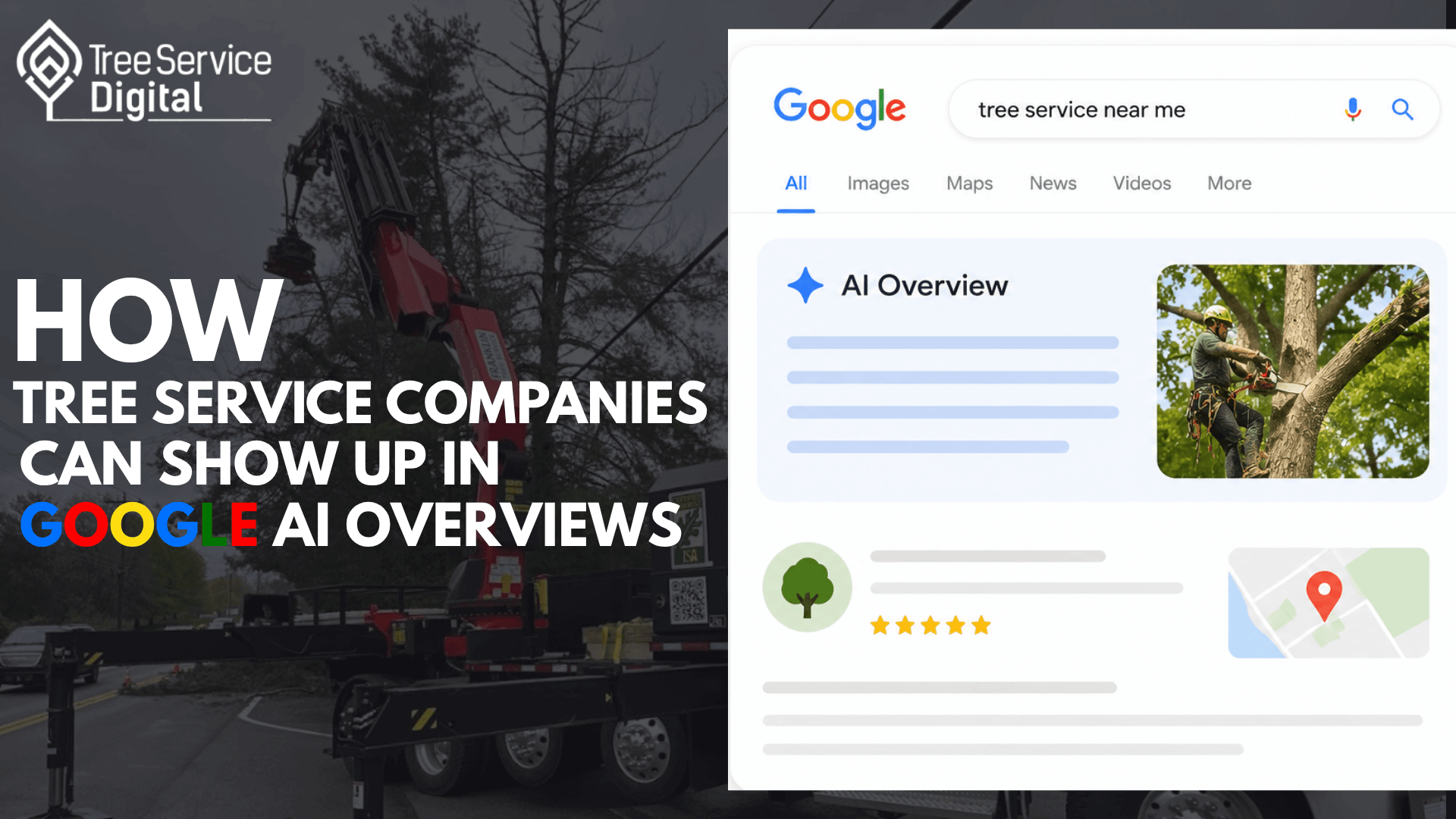
If you’ve searched for anything on Google lately, you’ve probably noticed something new sitting above the regular results: a big, AI-generated box that answers the question before you even click a link. That’s a Google AI Overview, and it’s quietly changing how homeowners find tree service companies in your area.
Here’s the number that should get your attention: 68% of local searches now trigger an AI Overview. Compare that to just 39% of searches showing the traditional local map pack, and you start to see the shift. Google isn’t replacing local search – it’s layering AI answers on top of it. And if your tree service business isn’t showing up in those AI boxes, you’re invisible to a growing chunk of people who are actively looking to hire someone.
The good news? You can do something about it. Here’s exactly what moves the needle.
First, Understand How AI Overviews Actually Work
The instinct most business owners have is to assume that ranking well in Google means you’ll automatically show up in AI Overviews too. That’s a reasonable assumption. It’s also mostly wrong.
Research from Search Engine Journal shows that 77% of AI Overview citations come from off-page sources – meaning review sites, directories, and third-party platforms – not from your own website. Google’s AI is pulling data from everywhere you exist online, not just your homepage.
Think of it like a background check on your business. The AI is cross-referencing your Google Business Profile, your Yelp listing, your Angi profile, your Facebook page, and any other place your business shows up. If those sources are consistent, complete, and credible, you have a shot at being cited. If they’re messy or outdated, the AI skips you.
The Three Levers That Drive AI Citations for Tree Service Companies
1. Location Page Structure: Give the AI Something to Work With
Your location pages – the pages targeting specific cities and towns you serve – are the foundation for AI Overview visibility. But most tree service websites get this wrong in the same way: they slap a city name into a generic template and call it a day.
AI systems look for what SEJ calls “fact density.” That means structured, specific content that answers the questions real customers are typing. For a tree service location page, that looks like:
- A clear list of services offered in that area (tree removal, stump grinding, emergency service, trimming, etc.)
- Honest details about response times and service area coverage
- Local landmarks or neighborhoods you serve, written naturally into the copy
- Customer testimonials that mention the specific city or neighborhood
- A FAQ section that answers “how much does tree removal cost in [city]” directly on the page
Google’s AI is looking for pages that read like they were written by a local expert, not assembled from parts. If your location page could apply to any town in America with a find-and-replace, it’s not going to cut it.
2. Transparent Pricing: This One Is a Bigger Deal Than You Think
Here’s a stat that surprised even me: “price and cost” queries trigger AI Overviews more than 80% of the time.
Think about what homeowners are actually searching. “How much does it cost to remove a tree in [city]?” “Tree trimming prices near me.” “Emergency tree removal cost.” These are among the most common searches a potential customer makes before they ever call anyone – and all of them are triggering AI Overviews.
If your website doesn’t address pricing, the AI Overview will cite a competitor who does. Or worse, it’ll cite a generic article from a home improvement site that has nothing to do with your market.
You don’t need to publish a rigid price list. What you need is a pricing page or a section on your service pages that:
- Gives realistic ranges (e.g., “Tree removal in [city] typically runs between $400 and $1,800 depending on size, location, and complexity”)
- Explains the variables that affect cost (proximity to structures, tree health, stump removal included or not)
- Addresses the questions homeowners actually have before they call
This kind of content does double duty: it qualifies leads before they contact you, and it gives AI systems something concrete to cite when someone asks about pricing.
3. NAP Consistency Across Directories: The Boring One That Actually Matters
NAP stands for Name, Address, Phone number. Getting these details exactly right, and exactly the same, across every directory where your business is listed is one of those unsexy tasks that most business owners either ignore or do once and forget about.
For AI Overviews, it’s critical.
The AI cross-references your business information across multiple sources before deciding whether to cite you. If your Google Business Profile says “Smith’s Tree Service LLC” but your Yelp listing says “Smith Tree Service” and your Angi profile shows an old phone number, that inconsistency creates doubt. The AI errs on the side of caution and cites someone whose information checks out cleanly.
Audit these platforms at minimum:
- Google Business Profile
- Yelp
- Angi (formerly Angie’s List)
- HomeAdvisor
- Apple Maps
- Facebook Business Page
- Bing Places
- Your local Chamber of Commerce listing (if applicable)
- Any industry directories like Tree Care Industry Association
Make sure your business name, address, and phone number are identical across all of them – not just similar, identical. Even differences in abbreviations (“St.” vs. “Street”) can create confusion.
What to Do This Week
If you want to start improving your AI Overview visibility right now, here’s the practical to-do list:
- Google your own business and see if you’re showing up in any AI Overviews. Search “tree service [your city]” and “tree removal cost [your city]” and note what you see.
- Run a NAP audit. Check your top 5 directories and make sure your business name, address, and phone number match exactly.
- Add a pricing section to your website. Even a page that explains what factors affect tree removal cost – without pinning down an exact number – is better than saying nothing.
- Review your top location pages. Do they have specific, local content with real fact density? Or do they look like a template? If it’s the latter, pick one page and rewrite it with the structure outlined above.
- Make sure your Google Business Profile is fully filled out. Services, photos, business description, Q&A section – all of it. This is one of the primary sources AI systems use when building local recommendations.
The Bigger Picture
Google AI Overviews aren’t going away. They’re going to get more prominent, cover more query types, and become the first thing more and more homeowners see when they search. The tree service companies that start optimizing for this now are going to have a real head start over competitors who wait until it becomes impossible to ignore.
The framework isn’t complicated. Strong location pages. Transparent pricing. Consistent listings. Do those three things well and you give Google’s AI a reason to feature your business instead of your competitor’s.
If you want help auditing your current setup or building out location pages that actually work for AI visibility, that’s exactly what we do at Tree Service Digital. Reach out and let’s take a look.
Wesley Smith is the CEO of Tree Service Digital and has been working in digital marketing since 2011. Tree Service Digital specializes in helping tree service and tree care companies grow their businesses through SEO, paid advertising, reputation management, and content strategy.
[/et_pb_text][/et_pb_column][/et_pb_row][/et_pb_section]
